



 Nov 02,2026
 By Nucleus Team
Key Takeaways
Collecting first-party data provides no competitive advantage unless it can be activated.
Connecting CRM platforms (such as Salesforce) with advertising channels (such as Meta and Google) bridges the gap between customer identity and behavioural intent.
Core first-party data activation strategies:
- Retargeting: Re-engage with high-intent prospects who haven’t converted yet.
- Cross-selling: Promote complementary products based on verified purchase history.
- Audience Suppression: Exclude active buyers to prevent ad spend wastage.
- Lookalike expansion: Use high-value customer profiles to seed acquisition campaigns.
Key technology solutions and integrations
Modern platforms like Nucleus enable direct first-party data activation across Salesforce CRM, MCE, Meta and Google Ad accounts, serving as a seamless replacement for legacy tools like Salesforce Advertising Studio within Journey Builder workflows.
Companies have never had more customer data.
CRM platforms contain purchase history, loyalty information, preferences, product relationships and years of customer interactions. Advertising platforms contain another incredibly valuable set of signals: browsing behavior, content engagement, clicks and advertising interactions.
Individually, both datasets are useful.
Together, they become much more powerful.
Yet for many marketing organizations, connecting the two remains surprisingly difficult.
That’s the gap between having first-party data and actually activating first-party data.
Advertising platforms know behavior. Your CRM knows the customer.
Think about what an advertising platform knows about someone.
It can understand what content they interact with, which ads they respond to and signals indicating what they might be interested in.
Now compare that with your CRM.
Your CRM may know that the same individual is already a customer. It may know which products they own, whether they’re part of your loyalty program, their customer status and their history with your organization.
That difference matters.
Without CRM context, an advertising platform may continue promoting a product someone already owns.
With first-party customer context, the marketer can make a very different decision.
And that’s where audience strategy becomes much more interesting.
Four ways first-party data improves advertising
There are countless applications, but four strategies illustrate the opportunity particularly well.
The table below shows the different strategies first-party data can unlock when running advertising campaigns:
| Strategy | Example | Value |
|---|---|---|
| Retargeting | Reach known prospects who did not convert | Higher relevance |
| Cross-sell | Promote a complementary product to existing customers | Greater customer value |
| Suppress | Exclude recent buyers or ineligible customers | Less wasted spend |
| Expand | Create lookalike or similar audiences from valuable customers | Better prospecting signal |
So why isn’t everyone doing this already?
This is one of the problems we’re addressing with Nucleus.
Our view is that audience activation shouldn’t exist as an isolated technical process.
It should be part of the campaign workflow.
A marketer should be able to:
- Connect the marketing and customer platforms they already use.
- Select or create the audience relevant to the campaign.
- Define the campaign, brand and objective.
- Configure the channels and touchpoints where the campaign will run.
- Activate the audience through those platforms without rebuilding the process every time.
That means connecting systems such as Salesforce CRM or Marketing Cloud with advertising destinations and making that activation accessible from the same environment marketers use to plan and execute campaigns.
What this looks like in practice
During our recent webinar, we demonstrated the different solutions available for Salesforce customers including Advertising Studio which became unrenewable in August of 2026 and Data 360 Ad Audiences which require the customer to implement Data 360.
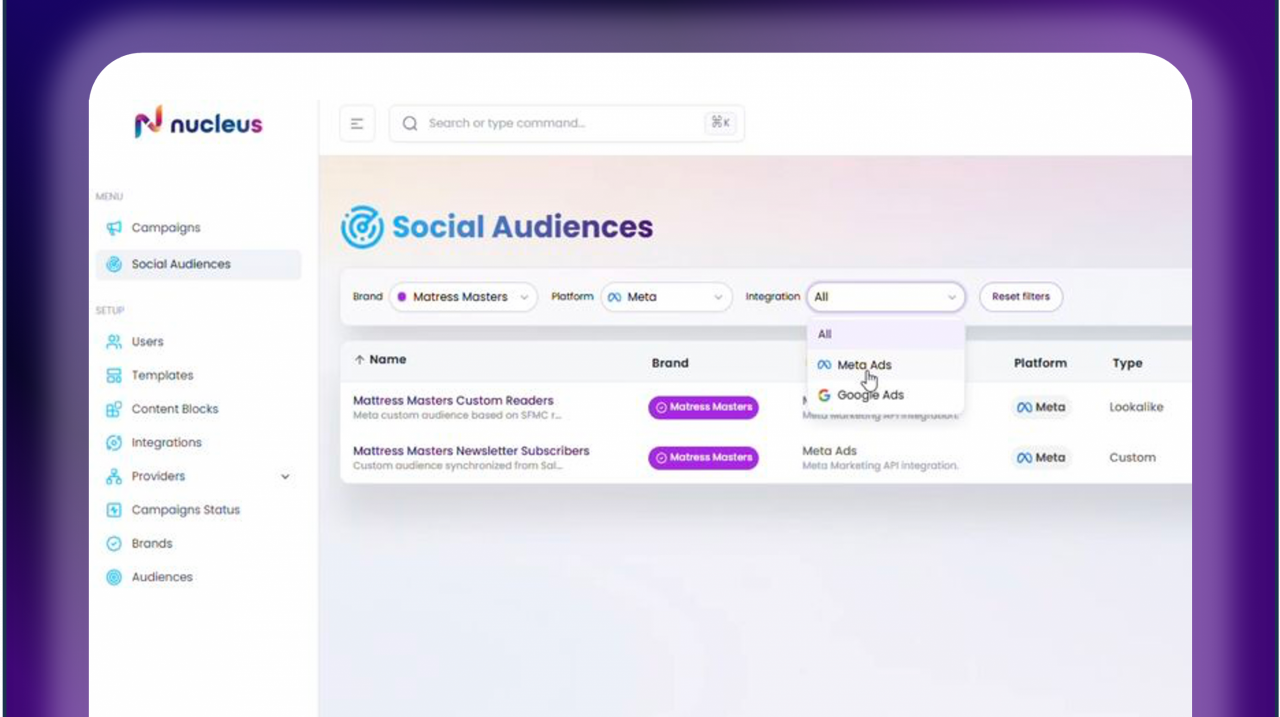
We also demonstrated our advertising audiences solution where marketers are able to easily connect their existing Meta and Google advertising accounts and publish first-party data from Salesforce CRM or Marketing Cloud Engagement into custom audiences for advertising campaigns.
Additionally, marketers can use the Nucleus integration in Journey Builder to add or remove contacts from a custom audience to retarget customers that haven’t engaged or to avoid paying for impressions on customers who are engaging with the content in the journey.
Collecting first-party data isn’t the strategy
Collecting first-party data is not, by itself, a competitive advantage.
Nearly every established organization has customer data.
The advantage comes from how quickly that information can be turned into action and the more automation and integration you have between you will be better equipped to engage with customers at the right time and in the right channel.
Contact us if you want to know more about how we are helping companies take advantage of their First-Party data in a sustainable and automated way.